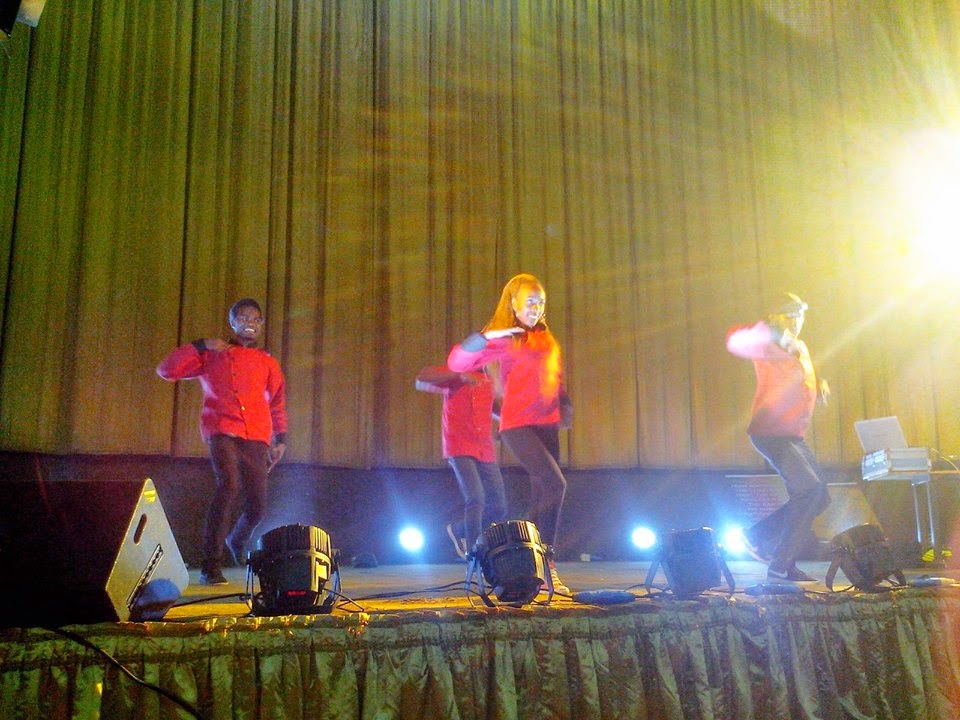
Sunday, 27 April 2014

Reason Why We Dance!!!

Why do you dance? Does dancing help you express your creativity? Does Dance pay? How do you make a living out of Dance? Do you feel empowered when dancing? This are among the questions not only I as dancer get but many other dance artists get out there... So today I decided to state a few reasons to why I (we) dance and that...................
Dancing has been around for as long as anyone would care to remember. It’s popularity has waxed and waned but recently it has had a resurgence again with TV shows such as " Sakata, Katika, Orange Beat ya Street, Step Up Revolution, Battle Of Year, Dancing With The Stars”, “So You Think You Can Dance” and with dance themed movies showing on the big screen.  What drives people to dance? If you just starting out or even thinking of starting, we have explored why people dance when for some of us, it’s a daunting task.
Here are some reasons why we dance.

Dancing has been around for as long as anyone would care to remember. It’s popularity has waxed and waned but recently it has had a resurgance again with TV shows such as “Dancing With The Stars”, “So You Think You Can Dance” and with dance themed movies showing on the big screen.
What drives people to dance? If you just starting out or even thinking of starting, we have explored why people dance when for some of us, it’s a daunting task.
- See more at: http://www.countiesdance.co.nz/reasons-for-dancing/#sthash.1vDGx0kT.dpuf

 Fun Dancing: is something that can brighten peoples lives. It’s relatively easy to do and people of all ages can take part and enjoy it. There is no age barrier in dancing unlike some forms of exercise. People often smile when they’re dancing because it feels good! (I’m not talking about theatrical smiles, although that probably started because people tend to naturally smile when they’re dancing.) 

Making friends: Dancing introduces you to new people, increasing your social circle. Dance links people together and it’s a great way of making new friends. There’s a common interest, and not too much pressure to talk because often people are focused on what their feet are doing. 

Exercise: Moving your body has plenty of health benefits both mentally and physically. Dancing is one of the best activities for working both your body as well as your mind. Health benefits include making bones stronger which minimizing the chances of osteoporosis, to keeping our joints lubricated which helps prevents athritis. Dancing also helps us exercise our minds with the moves that we learn and memorise, making our minds more alert and young. 

Building Confidence: By learning to dance you will learn how to carry yourself , correct your posture and build your self-esteem and self-confidence on and off the dance floor. 

Decreasing Stress: Dancing raises endorphin levels, which can help to heal stress and depression. It improves the harmony between our mind and body, giving us a sense of well-being.

Social expectations: Dancing may not be your cup of tea and that’s fine. There are a few times in your life when it’s nice to know a few of the basics.  There will be occasions like weddings, work functions and even out clubbing where knowing how to dance, even if it is only a few moves will be beneficial. Having some knowledge of dancing up your sleeve may help you impress people. 

Career choice: Dance can also open new opportunities in terms of careers. The entertainment industry is vast, employing an estimated 30,000 in dance related roles in the UK alone. There are numerous professions in dance from dancing, teaching, choreography or dance notation. In addition to this, people work in the dance industry as; community dance practitioners, promoters, producers, designers, publicists, technicians, physiotherapists, medical and alternative practitioners, therapists, writers and academics.


The skills developed in dance can also be valuable transferable skills that can be applied to any career path. The confidence gained through achievements in dance helps to build social skills, increase self esteem and the ability to communicate well in a group. These skills once built up through partaking in dance can lead to a variety of career routes. Taking the first step can be the hardest, but by using this blog you will qualified teachers, you can be assured of high quality of training.

B-boy Harry Foundation, Compass Nella Fitness Centre, Ongata Rongai.
Email: bboyharry@live.com - Phone: +254 700 472 451.
 

  • Fun Dancing is something that can brighten peoples lives. It’s relatively easy to do and people of all ages can take part and enjoy it. There is no age barrier in dancing unlike some forms of excercise. People often smile when they’re dancing because it feels good! (I’m not talking about theatrical smiles, although that probably started because people tend to naturally smile when they’re dancing.)
  • Making friends Dancing introduces you to new people, increasing your social circle. Dance links people together and it’s a great way of making new friends. There’s a common interest, and not too much pressure to talk because often people are focused on what their feet are doing.
  • Exercise Moving your body has plenty of health benefits both mentally and physically. Dancing is one of the best activities for working both your body as well as your mind. Health benefits include making bones stronger which minimizing the chances of osteoporosis, to keeping our joints lubricated which helps prevents athritis. Dancing also helps us exercise our minds with the moves that we learn and memorise, making our minds more alert and young.
  • Building Confidence By learning to dance you will learn how to carry yourself , correct your posture and build your self-esteem and self-confidence on and off the dance floor.
  • Decreasing Stress Dancing raises endorphin levels, which can help to heal stress and depression. It improves the harmony between our mind and body, giving us a sense of well-being.
  • Social expectations Dancing may not be your cup of tea and that’s fine. There are a few times in your life when it’s nice to know a few of the basics.  There will be occassions like weddings, work functions and even out clubbing where knowing how to dance, even if it is only a few moves will be beneficial. Having some knowledge of dancing up your sleeve may help you impress people.
  • - See more at: http://www.countiesdance.co.nz/reasons-for-dancing/#sthash.1vDGx0kT.dpuf
    Dancing has been around for as long as anyone would care to remember. It’s popularity has waxed and waned but recently it has had a resurgance again with TV shows such as “Dancing With The Stars”, “So You Think You Can Dance” and with dance themed movies showing on the big screen.
    What drives people to dance? If you just starting out or even thinking of starting, we have explored why people dance when for some of us, it’s a daunting task.
    - See more at: http://www.countiesdance.co.nz/reasons-for-dancing/#sthash.1vDGx0kT.dpuf
    Dancing has been around for as long as anyone would care to remember. It’s popularity has waxed and waned but recently it has had a resurgance again with TV shows such as “Dancing With The Stars”, “So You Think You Can Dance” and with dance themed movies showing on the big screen.
    What drives people to dance? If you just starting out or even thinking of starting, we have explored why people dance when for some of us, it’s a daunting task.
    - See more at: http://www.countiesdance.co.nz/reasons-for-dancing/#sthash.1vDGx0kT.dpuf

    Saturday, 26 April 2014

    CHALLENGES FACING KENYAN YOUTH.


    Most of the problems facing today’s youth are not restricted to any one ethnic or religious group, but affect young people generally. Most discussions on youth have focussed on issues such as drug abuse, crime, violence, sexuality and poverty. In addition to these, today’s youth are afflicted by not soo new challenges.

    i. Employment creation

    There are about 500,000 youth who graduate from various tertiary institutions ready to enter the job market every year. However, due to the slow economic growth, corruption, nepotism and demand for experience by potential employers, 75% remain unemployed. There is need for YOUTH ORGANISATIONS to develop policies that will address unemployment problems and create an environment where the youth can exploit their potential through value adding initiatives.

    ii. Empowerment and Participation

    One of the greatest challenges in Youth Empowerment and participation is how to ensure that young people are passionate about causing transformation in Kenya. Youth Empowerment and Participation is the quintessential force for causing such transformation. Young people need a youth branded platform from where they can speak powerfully, take appropriate action, and inspire belief that will have a catalytic impact all over the country through youth-led development initiatives. Youth empowerment and participation is a dynamic cycle. Overall, it is anticipated that the outcome of Youth Empowerment and participation is strong contribution to National prosperity, economic competition and reduced unemployment. When empowered, young people can contribute greatly towards good governance and democracy with a passionate desire to be catalyst for National Development. Having Youth Organisations can be a catalyst for youth empowerment and participation.


    iii. Health

    The uneven distribution of health facilities in the country continues to widen disparities in affordability and access to medical care. Statistics indicate that only 42% of the population has access to medical facilities within four kilometers and 75% within eight kilometres. Medical personnel are also too few to sufficiently address the health needs of the population, let alone those of the youth. Currently there is one doctor for every 33,000 people in the rural areas and 1,700 in the urban areas and it is estimated that only 12% of the health facilities are youth friendly.

    Health has become a major issue among the youth. Apart from the traditional health problems like malaria, tuberculosis and the more conservative sexually transmitted diseases, the exponential spread of HIV/AIDS and drug abuse have become issues of major concern. Mental health is increasingly becoming a common problem among the youth. Depression, anxiety, eating disorders, psychosis and substance abuse are also becoming leading mental problems among the youth.

    Furthermore, reproductive health is one of the issues with the greatest impact on the youth. Some related problems and side effects include teenage pregnancies and abortion. Other common health problems are malaria and acute respiratory infections, which account for about one half of outpatient cases. Other diseases the youth grapple with include skin infections, intestinal worms and diarrhoea.
    Current health facilities are also not youth-friendly. As such, there is a need for facilities that offer preventive and curative health services for the youth. Information on health should be made available to the youth too.


    iv. Education and training

    The 8-4-4 system of education was geared to imparting appropriate skills to enhance self-employment. However, due to the high costs, poverty and lack of facilities, there have been high school drop-out rates. Most of the youth either drop out of school or graduate without necessary skills for self-employment. Many girls drop out of school due to pregnancy.

    The country’s training institutions are also either inadequate or lack the essential facilities and technology to prepare students for the challenging market demands. Recently, sub-standard training institutions have come up to take advantage of shortage of training opportunities to exploit desperate youth. In most cases, there is no linkage between the training institutions and either the formal or informal (jua kali) sector. The youth trained in these institutions cannot, therefore, be immediately absorbed into the job market. Besides this, society’s attitude towards the Jua kali sector discourages many youth from venturing into it, as they do not want to be regarded as failures in life.


    v. Crime and Drugs

    The early mid 1980’s saw a rapid growth in crime, drug and substance abuse among the youth in Kenya. Alcohol, cigarettes, khat (miraa), and cannabis sativa have remained the most popular abused substances. There is a fast emerging trend of injecting drug use especially narcotic. Moreover, abuse of drugs is highly associated with the risks of contracting HIV/Aids and other sexually transmitted diseases especially among the youth.

    Violent criminal attacks, including rape, mugging, armed car-jacking and home invasions are increasingly being associated with the youth these days. Over 50% of all the convicted criminals are young people aged between 16 and 25 years. Despite that above trends, there are no studies done to confirm any relationship between the increased drug and substance abuse among the youth and the increasing rate of the crimes. Our Society must therefore collaborate with other stakeholders to research and come up with policies that would assist youth in this country overcome the challenge.


    vi. Leisure, recreation, and community service

    Leisure, recreation and community service are important for the psychological and physical development of the youth. It contributes to their personal development by promoting good health, personal discipline, leadership and team building skills. It also provides opportunity for appreciation, participation and creative experience in leisure, music, art, dance, drama crafts, novelty events service and cultural activities. This helps engaging the youth to make good use of their leisure time, express their beliefs and values as well as promote and preserve local art and culture for the benefit of the future youth.

    However, current investment in leisure and recreation has not reflected its importance. The sector suffers from inadequate funds and facilities while the talented youth lack motivation and are often exploited by organizations. Due to these constraints, it has not been possible to tap fully the talents of many youth.


    vii. Youth and Environment

    Degradation of the environment, through pollution, poor waste management and deforestation, is a major challenge for Kenya. With the ensuing destruction of water catchments, depletion of fish and other marine stock, pollution of rivers and destruction of plants and animals, the youth cannot be assured of quality life in the future. The need to conserve the environment has become increasingly important and many youth organizations are engaged in activities to protect the environment such as tree planting, clean-up campaigns, bio-diversity conservation, wildlife preservation campaigns and agro-forestry.

    viii. Information and Communication Technology

    Information and Communication Technology (ICT) may arguably be the most powerful tool for social and economic change. Rapid and continuing growth and development in ICT is transforming the ways in which youth live and work. Using internet for example, youth can get access to both domestic and international education and job opportunities on line. They can also share interests with peers and with the YEDF, can even advertise their products and get market information on any business of their choice.

    Due to lack of access to information and communication technology (ICT) especially in rural areas, youth cannot exploit their career, business and education opportunities. There is need for Youth in our society to take advantage of benefits associated with ICT to foster youth development.

    ix. Youth with Special Needs

    The categories of youths with special needs have been identified as the: Unemployed youth; Out of school youth; Female youth; Youth infected and affected by HIV/Aids; Street youth; physically, and mentally challenged youth; and Youth in difficult circumstances. The Foundation will adopt an affirmative action of 15 percent in its programmes in favour of youth with special needs.

    x. Access to Financial Resources

    Traditional financial institutions have avoided lending to youth due to their relative inability to comply with the high transaction costs, difficulty in assessing and managing their risk profile, and lack of the required financial documentation as well as collateral.

    The Ministry of State for Youth Affairs in partnership with various private Financial Intermediaries is administering the Youth Enterprise Development Fund to the youth. This fund has been specifically tailored to enhance the youth to develop with focus on self employment via entrepreneurship initiatives.

    Youth can access these funds either as individuals or as groups and the collateral to secure the monies borrowed have been made affordable in the sense that they can be in form of group guarantee, guarantee by parents, relatives or and even community leaders... With these eased regulations, we are in a society that hopes that youth in the country will be able to work towards the realization of their life goals that were hindered by the tough regulations that have in the past barred them from accessing credit facilities. 


      In closing, let us recognize that we have a serious challenge on our hands: to ensure that today’s children (tomorrow’s adults) would experience a better world than we are living in today. We should all work towards this objective and not wait for a crisis to occur and then react, let us be prepared.
    B-boy Harry Foundation, Compass Nella Fitness Centre, Ongata Rongai.
    Email: bboyharry@live.com - Phone: +254 700 472 451.

    Thursday, 24 April 2014

    A RECAP OF DANCE UNPLUGGED IV.


                         A Recap of Dance Unplugged IV Great Dance Artists and Krews Showed up it was one historic event.... More Photos Still Coming.... Keep it here!!!!


                                                              B-boy Harry Foundation, Compass Nella Fitness Centre, Ongata Rongai.
    Email: bboyharry@live.com - Phone: +254 700 472 451.

    Saturday, 5 April 2014

    IS KENYAN HIP HOP SCENE DEAD???

    Kenyan hip hop is a subgenre of hip hop music: that which originates the country of Kenya. It defines a growing genre in contemporary Kenya. Kenyan hip hop commonly is a combination of Swahili and English (Kenya's official languages) as well as Sheng and various tribal languages.Early Kenyan hip-hop imitated the styles of the United States, with musicians wearing American clothes and rapping in English. This influence was perpetuated by access to internet and, in particular. According to the documentary “Hip-Hop Colony,” the beginnings of Kenyan hip-hop were like a “new breed of colonialism,” transplanting the original styles from the Westernized world to Africa. However, Kenya has not only embraced but appropriated the genre, creating its own distinct version. Since its explosion in the mid-1990s, Kenyan hip-hop is now generally written and performed not only in English but also in Swahili and in Sheng, a slang combination of the two.
    Jimmy Gathu was one of the earliest known rappers on the Kenyan scene with his hit song "Look, Think, Stay Alive" released in 1991, a song dealing with road safety. However, the first major commercial hip hop hit came in 1996 with Uhiki by Hardstone (Harrison Ngunjiri) which sampled a Kikuyu folk song and Marvin Gaye's sexual Healing,[4] produced by Tedd Josiah of the then Audio Vault Studios (now, Blue Zebra). Other popular pioneering acts were Kalamashaka with their national hit "Tafsiri Hii",[4] K-South with "Nyabaga Kodo Gakwa," (which was also sampled from a Kikuyu folk song like Uhiki by Hardstone) and also the late Poxi Presha with his break out hit "Dhako Kelo".[4]
    Gidi Gidi Maji Maji emerged in 1999 with their hit "Ting Badi Malo" and released the debut album, "Ismarwa" the following year. They went on to released their popular and politically charged hit Unbwogable in 2002. The word took on the meaning of unshakable, unstoppable, or unbeatable and was subsequently used by major politicians and in 2008 in reference to then-candidate Barack Obama.[5][6]
    Into the new millennium, many new groups and solo artists have emerged and the scene musically diversified. Among the most famous artists are Necessary Noize, Redsan, Nameless, Nonini, Wawesh, the late E-Sir, and Juliani.[7]
    I wonder where did the heavyweights go?????????

    B-boy Harry Foundation, Compass Nella Fitness Centre, Ongata Rongai.
    Email: bboyharry@live.com - Phone: +254 700 472 451.

    Tuesday, 1 April 2014

    TYPES OF WOMEN, MEN SHOULD NEVER DATE!

    Men, this is exclusively for you. Have you ever wondered why the women you date always turn out to be annoying or weird in some way? Have you ever thought that perhaps you have been choosing the wrong type of women? Below is a list of ten different types of women you should avoid, according to an article I just came across. Read carefully and see if you can learn one or two things.

    1. The Chatterbox. This is the woman who never shuts up, barely stopping to breathe. Seemingly only concerned about what is going on in her life, she always has to make a comment about everything and dominates conversations.
    2. The Desperate Chick. This type of woman will seem fantastic at first, until she starts talking about your wedding location, how many kids she wants and the name of your future dog–right after the first date! When a woman advances WAY faster than normal, watch out. She NEEDS a man so bad that she’s willing to put anybody in that slot, even the homeless guy on the corner.

    3. The Overly-Critical Woman.
    Anything you do for this type of woman is simply not good enough. Nothing seems to work unless it is done according to her standards. Anything that is said by anyone will be quickly taken out of context to become some sort of insult or some reason to wage war against the world. This type of woman has plenty of emotional baggage and will make you an angry and bitter person as there will be nothing but misery with her.

    4. The Bimbo.
    This type of woman can’t obtain a GED but has managed to secure a PhD in the science of the bedroom. This is an intellectually challenged woman who looks great but, in all honesty, shouldn’t open her mouth. Her skills are unquestionably only rooted in the physical realm and unless you’re just after one-night stands, you do not want to bring a stupid girl home to meet Mom and Dad. The majority of girls you see on the streets everyday fall into this category,

    5. The High Maintenance Chick.
    If this type of woman breaks a nail, she expects you to drop everything you’re doing to drive her to the salon immediately. Her daddy always told her she was a princess and she expects to be treated like one at all times. She has expensive taste and expects you to shower her with only the best things and take her out to posh places on a regular basis. If you don’t have a lot of money and a penchant for luxury, don’t even bother.

    6. The Clingy Girl.
    This woman is a nuisance who can’t go anywhere or do anything without the company of her man. She’ll adopt your interests, calls 20 times a day and fly off the handle anytime she’s not around to monitor your behavior. This type of woman will smother any chance of you missing her by insisting that you spend every waking moment with her, refusing to let you go out with the boys or spend any significant amount of time with anyone else.

    7. The Baby’s Mama.
    This woman has a great physique, great personality and her toes are pretty too! There’s only one problem–she’s got a pretty large amount of children with assorted “baby-daddy’s”, and when women like this get desperate, any and every guy has the potential to be “daddy.” This woman got knocked up by somebody that she was supposedly in love with, and not only is she a bad judge of character, she’s GROSSLY irresponsible. The same guys that are “jerks” now are the same guys she once thought the world of and had unprotected sex with.

    8. The Gold Digger.
    The Gold-Digger will compliment you on your expensive watch, ask you what kind of car you drive, what you do for a living, where you live and so on. Like the high maintenance woman, the Gold Digger is basically looking for a sugar daddy, she’ll size you up within the first five minutes and drop you just as quickly if your cash flow runs out and you can’t take her shopping anymore. These types of women will just suck your wallet dry and leave you emasculated. Fortunately,you can usually see this type coming from a mile away. She wants to write out the names of all her designer items and post it on Instagram, Twitter and Facebook.

    9. The Club Girl.
    Club girls are nothing more than fantasy women who have been practically living in bars and clubs since they hit the legal drinking age. They have beautiful faces with full lips, big doe eyes, great legs, and all the curves you could ever ask for. The problem in dating these women is that they love to wear clothes that show off their great assets not just to you, but to every Tom, man-hood and Harry on the street. A woman like this may be carefree and wild; however, once you take a closer look, you’ll realize that her entire life is a party and most nights will end with her puking in your car. Or waking up hungover, in some guy’s bed in the morning.

    10. The Feminist.
    This type of woman can never be pleased by a man and she believes that men are the cause of all the pains and suffering of society. It is her strong belief that women are much more intelligent than men and are capable of doing things “the right way”. You don’t want to waste any time with this type of woman because anything that you do will always be negative to her.
    B-boy Harry Foundation, Compass Nella Fitness Centre, Ongata Rongai.
    Email: bboyharry@live.com - Phone: +254 700 472 451.


    Tuesday, 18 March 2014

    DANCE COMPETION AND WORKSHOP @SARAKASI DOME!!!

    The dance convention And Competitions 2014 which is organized by campus Glamour in partnership with Sarakasi Trust is expected to be the first of many series of annual dance workshops and competitions intended to bring together Dancers and professional choreographers drawn from different backgrounds to showcase and share the knowledge of dance.


    Two segments in One event :::

    1. Dance Workshop -> three topics of discussion by professionals in the dance industry.

    ----Choreography
    ----Branding and Marketing
    ----Financial Intelligence

    2. Dance Competitions both individuals and groups are allowed to participate
    4th April.


    B-boy Harry Foundation, Compass Nella Fitness Centre, Ongata Rongai.
    Email: bboyharry@live.com - Phone: +254 700 472 451.


    Saturday, 15 March 2014

    Kenyan Traditional African Dances.

    Music is an international language and with it comes a dance. Dancing is not uncommon in the Africa culture as it has over the years been used to mark the different special occasions and celebrations. There are 8 provinces in Kenya but five major regions. Each of these regions has a popular ethnic group with unique dancing styles; Northern Kenya, Western Kenya, Central, Coast and Eastern Kenya.
    The Maasai Dances of Northern Kenya. The north is represented by the famous Maasai tribe. This ethnic community has managed to withstand the test of time and retained its rich traditions and attires. The Maasai have a distinct dance that involve making a circle and jumping up high. The women wear bead necklaces or shanga round their necks which they use to dance as they sing their traditional music. The beautiful colors of their shukas and beads combined with their mowhawk kind of hairstyles separates them from any other dancers in Kenya.  


    Chakacha  of Coastal kenya unlike the Maasai dances, coastal dances focus mainly on vigorous waist movements. Chakacha is a very popular dance amongst the coastal tribes and their music is usually traditional or Taarab. With Taarab music and dancing, the instrumentals take up most of the song giving both the dancers and the performers time to shake their waists and move their hands freely. The major difference between chakacha and Taarab is the tempo of the songs with chakacha being the faster kind of music.
     

    Kamba Dances in the Eastern Province The eastern province is synonymous with the Akamba people whose traditional dances involve shaking their shoulders while stamping their bare feet. Their music is usually accompanied by drum beats and flutes. Percussion instruments were used to accompany song and dance depending on the occasion or ceremony.


    Mwomboko of Central Region. Central Kenya is famous for its hilly terrain and the great Mountain of God, Mount Kenya. The most populous tribe are the Agikuyu whose dances concentrated on foot and hand movements. The rythimic stamping of feet and sequential arm movements make up most of the dances in that area. Mwomboko is one of the most popular dances in that area and can be compared to a waltz or a slow paced salsa dance. The leg movements of both male and female are systematic and one missed step ruins the whole performance. This dance is one of the least vigorous dances in Kenya.
    Isukuti in Western It is with much vigor and passion that the people of western Kenya dance. They probably have the most energetic dances that combine all the other four dancing styles. Unlike the coastal people who shake their waists, or the people from central whose main focus is the feet, or the northerners who love to jump and the easterners who shake their shoulders, the people of western Kenya shake their whole body. Accompanied by the famous Isikuti drums and the karingaringa, a metallic circular instrument that is hit to produce sound, these people love to dance. They dance during all ceremonies, be it a funeral or a wedding. However their most colorful dances are performed during their annual circumcision ceremonies.
     Each of the dances is performed on special occasions like initiation, marriage ceremonies or even funerals. They are easy to learn by observation and can be very entertaining.


    B-boy Harry Foundation, Compass Nella Fitness Centre, Ongata Rongai.
    Email: bboyharry@live.com - Phone: +254 700 472 451.